

Last updated: November 2026
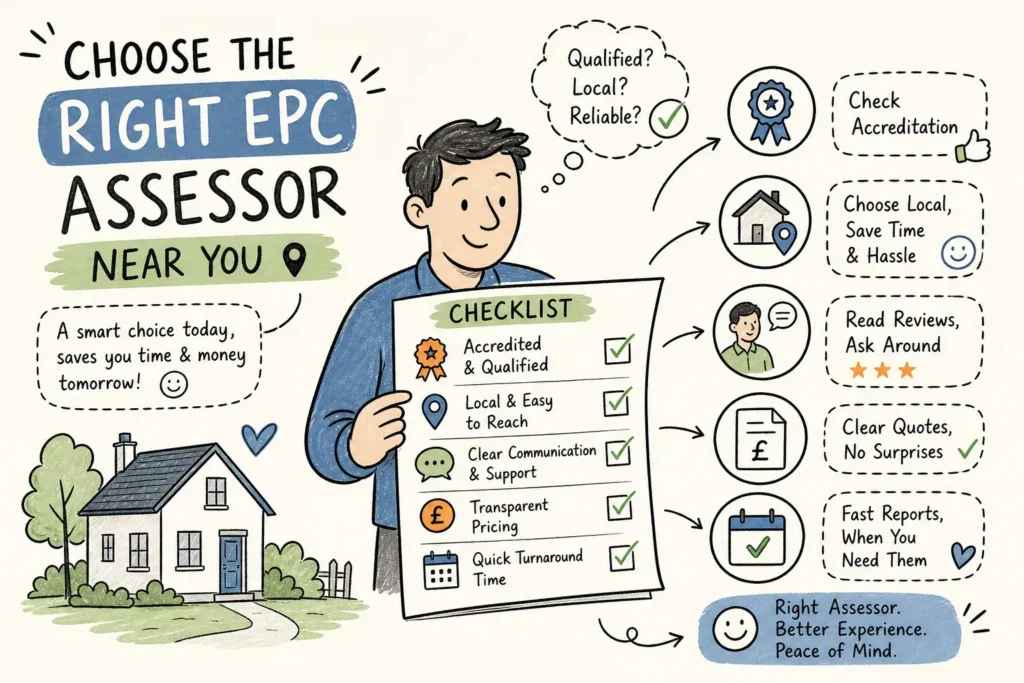
Searching for a reliable EPC assessor near me? The quickest way to filter the field is to confirm the assessor belongs to a government-approved accreditation scheme such as Elmhurst Energy or ECMK, check that they use the current RdSAP 10 methodology, and ensure their quote covers both the inspection and certificate lodging on the official register, ideally with a same-day visit and the certificate lodged within 24 hours of the visit. Those criteria alone will cut out most unreliable options before you even pick up the phone.
An EPC is a legal requirement before you market a property for sale or rent in England and Wales. The wrong assessor can delay your sale, invalidate your certificate, or leave you exposed ahead of the 2030 MEES deadline. At Green Homes EPC Limited, we serve homeowners and landlords across London, Essex, Kent and the Home Counties with an accredited, DBS-checked assessor, fast turnaround and practical compliance advice included as standard. This checklist walks you through every step, from understanding what happens during an assessment to booking the right local EPC assessor for your property.
Key takeaways
- Accreditation is non-negotiable: Your assessor must belong to a government-approved accreditation scheme, or their certificate cannot be lodged and has no legal standing.
- RdSAP 10 is the current standard: Any EPC produced for an existing home in England and Wales from 15 June 2025 onwards must use this updated methodology.
- Lodging date is what counts: A certificate delivered to your inbox but not lodged on the official EPC Register gives you no legal protection.
- Same-day visits are often available with us: we can often visit on the day you book, and the certificate is lodged within 24 hours of the visit.
- MEES 2030 affects landlords now: Properties rated D or below need an assessment today so improvement works can be planned before the October 2030 deadline.
- Direct booking saves money: Going directly to an accredited EPC assessor is often cheaper than booking through an estate or letting agent.
What does an EPC assessment actually cover?
An EPC assessor carries out a visual, non-invasive survey of your home. They record the construction type, floor area, insulation levels, window glazing, heating system, hot water provision, lighting, ventilation, and any renewable energy features such as solar panels or heat pumps. For a standard home, the visit typically takes 45 to 90 minutes; larger or more complex properties take longer.
RdSAP 10: the current assessment methodology
The data collected feeds into RdSAP 10, the government-approved Reduced Data Standard Assessment Procedure now in use for existing homes across England and Wales. This replaced the previous RdSAP 9.94 methodology on 15 June 2025. RdSAP 10 produces a SAP score that translates into the A–G energy efficiency rating shown on the certificate, and it requires assessors to collect more measured, property-specific information rather than relying on age-based defaults. This matters: the same property can receive a different rating under RdSAP 10 compared with an older assessment, particularly where window details, heating evidence or insulation records were not fully captured previously.
What the finished certificate shows
The certificate displays your current energy rating and estimated fuel costs, the potential rating if recommended improvements are made, and a list of suggested measures. The certificate is valid for ten years unless a new one is commissioned, but it only carries legal weight from the moment it is lodged on the official EPC Register. An unlodged certificate, however quickly delivered to your inbox, has no standing in law.
Why does a valid EPC matter when selling or letting?
A valid EPC must be commissioned before you market a property for sale or rent, before listing, not after offers come in. Estate agents are legally required to include the EPC rating in property advertisements, and landlords must provide a copy to prospective tenants free of charge. Penalties can apply and local authorities may issue fines for non-compliance, so it pays to get the certificate in place before you go to market.
The current minimum EPC rating for private rented properties in England is E. A property rated F or G cannot legally be let unless the landlord holds a valid registered exemption. Looking further ahead, the government’s proposed MEES deadline of 1 October 2030 would require all privately rented homes to achieve a minimum Band C rating, covering both new and existing tenancies. The government’s January 2026 response sets one compliance deadline of 1 October 2030 for all private tenancies in England and Wales.
If your property currently sits at D, E, F, or G, an up-to-date assessment under RdSAP 10 tells you exactly where you stand and what improvements the certificate recommends. That gives you enough lead time to commission works, obtain quotes, and schedule installation before the deadline. We include clear MEES compliance advice alongside every assessment at Green Homes EPC Limited, which is particularly useful for landlords planning their improvement programmes now.
How do you check a local EPC assessor’s accreditation?
In England and Wales, domestic energy assessors must belong to a government-approved accreditation scheme, such as Elmhurst Energy or ECMK. An assessor must belong to an accredited scheme to produce and lodge a valid domestic EPC. An unaccredited assessor’s certificate cannot be lodged on the register and has no legal value, full stop.
Verifying credentials is usually quick, a few minutes at most. Ask the assessor for their scheme name and membership number, then use the GOV.UK “find an accredited assessor” tool: search by name or membership number and confirm the returned profile shows current accreditation for domestic energy assessments. Each scheme also maintains its own online member register. If an EPC already exists for the property, the lodged certificate on the EPC Register names the assessor and their scheme, giving you a quick cross-check.
Look for assessors with a clear, stated same-day or next-day availability, and confirmation that the certificate is lodged within 24 hours of the visit. Direct bookings are often cheaper than sourcing an assessor through an estate or letting agent, who may add a markup to the base fee, so it is worth approaching an accredited EPC assessor directly where possible.
What does an EPC cost, and how quickly can you get one?
At Green Homes EPC, domestic EPCs start from £65 for a 1-bed flat, with no hidden extras. The price table below shows every property size.
For context, HomeOwners Alliance data for 2026 puts the typical cost of a domestic EPC at £44–£104, with roughly £65 as a useful national average.
Our domestic EPC prices, with no hidden extras:
| Property | Price |
|---|---|
| 1-bed flat | £65 |
| 2-bed flat | £75 |
| 3-bed flat | £85 |
| 2–3 bed house | £85–£120 |
| Larger house (for example a 3-bed house with an extension, conservatory or loft conversion, and bigger homes) | £120+ |
Prices can change, so please check when you book. A floor plan is free with every EPC booked by 30 November 2026.
The key cost factors are property size and complexity, your location, how you book (direct versus through an agent), and urgency. Same-day visits are often possible, though not guaranteed. There is no travel charge with us, and it is worth asking any assessor about extra fees upfront.
When you compare quotes, check that the price covers both the inspection and lodging on the official register. A fast visit that results in a certificate lodged several working days later is not genuinely fast when you are trying to market a property. Confirm the lodging timescale explicitly, not just the inspection timescale.
How to prepare for your EPC assessment visit
Documents and details to gather beforehand
Gather a few key pieces of information before the assessor arrives. Know your property’s approximate construction age and type. Have details of any loft insulation, cavity wall insulation, or solar panels installed, with installation dates if available. If you have building regulations completion certificates or installer certificates for energy improvements, have them to hand: documented evidence of improvements can directly affect your rating under RdSAP 10, rather than the assessor relying on age-based assumptions.
Making access straightforward on the day
Locate your boiler make and model, identify your heating controls and hot water cylinder if applicable, and note your meter type. Then ensure the assessor can reach the loft hatch, boiler cupboard, hot water cylinder, all rooms, and the electricity meter without delays. Secure pets, unlock any gate, and clear obstructions from the loft entrance. If a tenant occupies the property, confirm access arrangements in advance. The assessor cannot assess what they cannot see: a locked loft or inaccessible boiler forces assumptions that may lower the rating unnecessarily, and those assumptions are harder to dispute after the certificate has been lodged.
How to find an EPC assessor near me and book locally
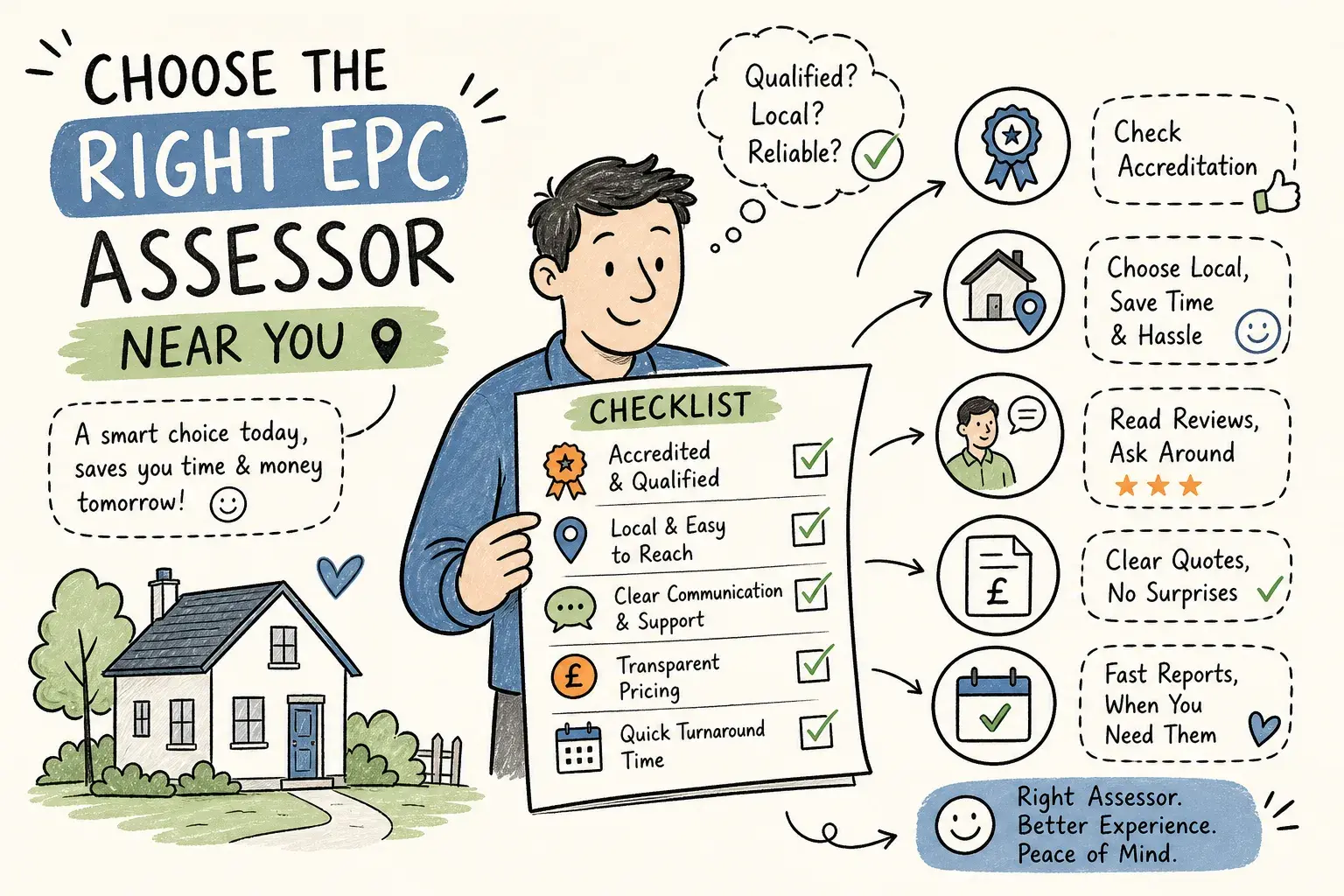
Bring the checklist together before you fill in a booking form. Confirm the assessor belongs to a government-approved accreditation scheme; Elmhurst Energy and ECMK are both strong choices for the rigour of their member vetting. Ask explicitly whether they use RdSAP 10. Establish the lodging timescale, not just the visit time. Then get an all-inclusive price covering both the assessment and certificate registration. An assessor who meets all four points is worth choosing over one who undercuts on price but lodges the certificate several days later.
For homeowners and landlords across London, Essex, Kent and the Home Counties, we at Green Homes EPC Limited meet every point on that checklist. I am accredited through both Elmhurst Energy and ECMK, and DBS checked. I use the current RdSAP 10 methodology and deliver EPCs lodged on the official government register within 24 hours of the visit. MEES compliance advice comes as standard with every assessment, which is particularly valuable for landlords with properties currently rated below Band C.
We cover a wide area, including London boroughs, Essex towns such as Romford, Basildon, and Southend-on-Sea, Kent locations including Dartford and Gravesend, and the wider Home Counties. Booking is straightforward: book online or call 0800 0025 394, with flexible scheduling to suit your availability. If you are still comparing options, the GOV.UK “find an accredited assessor” tool lets you verify the credentials of any energy performance certificate assessor near you before you commit.
Already have an EPC and want to improve the rating? Read our guide to how to improve your EPC rating.
Frequently Asked Questions
What happens if I use an unaccredited assessor for an EPC?
An EPC produced by an unaccredited assessor cannot be lodged and has no legal value. This means the certificate will not protect you when marketing a property, and it cannot be used to meet legal requirements for sale or letting.
When must I commission an EPC relative to marketing my property for sale or rent?
You must commission a valid EPC before you market the property, not after offers come in. Estate agents must include the rating in advertisements and landlords must have the certificate in place to avoid penalties and fines for non-compliance.
Do tenants have a right to receive a copy of the EPC?
Yes, landlords must provide a copy of the EPC free of charge to prospective tenants. Supplying the certificate is part of the legal requirements when letting a property.
What can I do if the assessor makes assumptions because they couldn’t access part of the property?
If areas are inaccessible the assessor will make assumptions that may lower the rating, and those assumptions are harder to dispute after the certificate has been lodged. To avoid this, ensure loft hatches, boiler cupboards and other areas are accessible and provide any installation or building-regulation certificates at the visit so the assessor can record measured, property-specific information.




1 thought on “How to Choose an EPC Assessor Near You: A Checklist for Homeowners and Landlords”
Love your blog. Do not stop posting!