EPC for Period Properties in Brentwood: What Homeowners Need to Know
“I recently carried out an EPC assessment on a beautiful period property here in Brentwood, and it got me thinking. Brentwood has a real concentration of older, characterful homes — far more than people realise until they start looking. If you own one, or you’re buying one, the EPC process works a little differently to a modern new-build, and it’s worth understanding why before you book an assessment”.
This guide covers what actually happens when we assess a period property, why they tend to score lower on paper, and what you can (and can’t) do about it — without stripping out the character that makes these homes special in the first place.
Why Brentwood Has So Many Period Properties
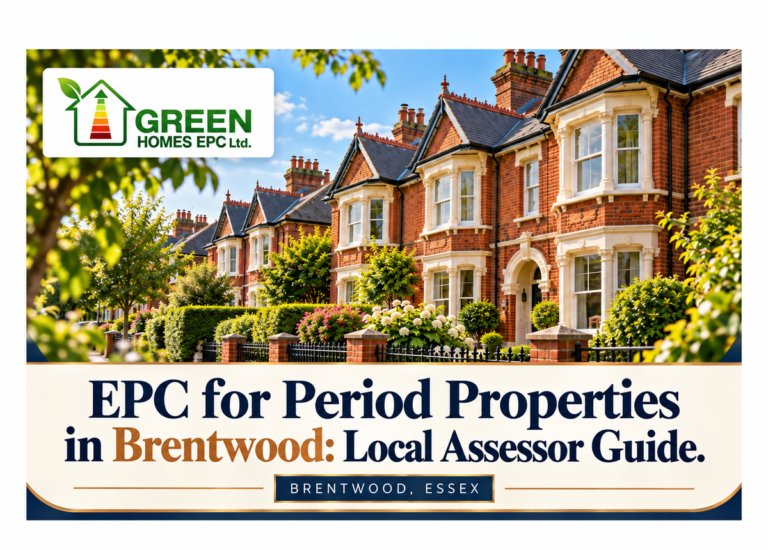
Brentwood’s town centre conservation area is older than most people passing through it on the High Street would guess. Shenfield Road is lined with imposing Georgian houses in red brick, many with the flared headers, tuck-pointing and sash windows typical of the period — properties like Roden House and Newnum House are good examples. Ingrave Road has a similar character, with spacious Georgian houses set well back from the road.
Go back further and there’s genuine medieval fabric still standing, even if it’s not always obvious. Timber-framed buildings survive on the High Street, including sections dating to the 15th century, and much earlier medieval and Tudor fabric survives hidden behind later brick frontages — a lot of Brentwood’s oldest buildings are hiding in plain sight behind a more “ordinary” looking facade.
Then there’s the Victorian and Edwardian layer: terraced housing and commercial buildings from the 19th century, built in stock brick, forming a lot of the residential streets closer to the centre.
If you own a home in Brentwood — particularly around the town centre, Shenfield Road, Ingrave Road, or the older parts of Shenfield and Warley — there’s a decent chance it falls into one of these categories.
Why Period Properties Often Score Lower on an EPC
This is usually the first surprise for homeowners. A beautifully maintained Georgian or Victorian home can still come back with an EPC rating in the D, E or even F band, and it’s rarely because anything is wrong with the property. It’s because the EPC calculation is largely about construction method and building fabric, not condition or character.
The most common factors we see on period properties in Brentwood:
Solid wall construction. Most homes built before the 1920s have solid brick walls rather than the cavity walls used in later housing. Solid walls lose heat faster and can’t be insulated with standard cavity wall insulation — the fix (internal or external wall insulation) is more involved and, on a period facade, needs to be done sensitively.
Single glazing or slim-profile windows. In a conservation area, or on a listed building, you often can’t simply swap in modern double glazing without planning consent — and sometimes not at all, if it would change the building’s character.
Older heating systems and controls. Many period homes have been re-plumbed over the decades but still lack modern heating controls (zoning, smart thermostats, TRVs throughout).
Solid or suspended timber floors without underfloor insulation, which is common in Georgian and Victorian construction.
None of this means the EPC assessment is “unfair” to older homes — it’s just measuring something different to how habitable or well cared-for a property is. A cold-feeling EPC rating and a genuinely lovely home to live in aren’t contradictory.
Do Listed Buildings Still Need an EPC?
This is one of the most common questions I get asked on period properties, and the honest answer surprises people: listed buildings are not automatically exempt from needing an EPC.
There’s an exemption in the regulations, but it only applies where meeting minimum energy-efficiency requirements “would unacceptably alter [the building’s] character or appearance” — and that has to be assessed on the individual property, not assumed because a building holds Grade I, Grade II* or Grade II listed status. Being in a conservation area doesn’t create an automatic exemption either.
In practice, this means:
-
- Most period properties in Brentwood, listed or not, will still need a valid EPC to be sold or let.
-
- The rating itself may be lower than a modern home, and that’s expected and normal.
-
- If you’re a landlord, the rating matters more than the fact of having one — which brings us to compliance.
Improving Your Period Property’s EPC Rating — Without Losing Its Character
The good news: there’s usually more room for improvement than people expect, and it doesn’t have to mean uPVC windows or spray foam insulation. The changes that tend to move the needle on a period property, in rough order of ease:
-
- Draught-proofing around doors, windows and floorboards — low-cost, reversible, and often the single best value-for-money improvement on an older home.
-
- Secondary glazing rather than replacement windows — keeps the original glass and frames intact (often a requirement in conservation areas) while significantly improving thermal performance.
-
- Loft insulation, where there’s roof space to work with — one of the most cost-effective upgrades on any property, period or not.
-
- Heating controls — thermostatic radiator valves, zoning, a smart thermostat — genuinely help the score even without touching the building fabric.
-
- Low-energy lighting — a small contribution, but a quick and completely non-invasive one.
Wall insulation (internal or external) can make a bigger difference, but it’s the one to plan carefully — done badly on a period property it can trap moisture in solid walls and cause damp problems, and on a listed building or in a conservation area it may need consent. This is usually a “get proper advice first” job rather than a DIY weekend project.
What This Means If You’re Selling or Letting a Period Home in Brentwood
If you’re selling, the EPC is a legal requirement before marketing the property — buyers will see the rating, but a lower rating on a genuinely characterful Georgian or Victorian home rarely puts off the kind of buyer who’s chosen a period property in the first place. It’s expected.
If you’re letting, it’s more consequential: privately rented properties currently need to meet a minimum E rating under MEES, with valid exemptions available (and registrable) where achieving that rating isn’t practically possible without unacceptably altering the property. Given that MEES requirements have been under review for a further tightening, it’s worth getting your current rating checked well ahead of any sale or re-let, rather than finding out at the last minute.
Why Local, Hands-On Experience Matters Here
An EPC assessment on a 1780s Georgian townhouse isn’t the same job as one on a 2015 new-build — the construction details matter, and getting them right affects the accuracy of your rating (and sometimes the recommendations that come with it). Because we work across Brentwood regularly, we’ve assessed a good spread of the town’s older housing stock — from Shenfield Road’s Georgian houses to Victorian terraces closer to the centre — and we know what to look for.
Same-day appointments are available, and certificates are typically issued within 24 hours.
Call us on 0800 0025 394 or email info@greenhomesepc.co.uk to book your period property EPC in Brentwood.